






Exhibitions 16.09.2026
29.09.2026
European fashionfashion exhibitionfashion history
How the masculinisation of female fashion challenged the gender binaries of an epoch
“A woman must have money and a room of her own if she is to write fiction,” lucidly states Virgina Woolf in the 1929 essay A Room of One’s Own, a written adaptation of speeches delivered to students at women’s colleges in Cambridge. Through a fast-paced, almost breathless – yet remarkably clear – prose, the author argues that women’s lack of economic and domestic emancipation was directly linked to the difficulties in expressing their creative, professional, ultimately true identity.
Echoing Woolf’s title, the Palais Galliera’s latest exhibition A Wardrobe of One’s Own: Dissident Femininities in the 19th Century re-activates this thinking, injecting it into the contemporary Parisian cultural programme through the lens of dress history. The curatorial and research work focused on revealing a still underlooked phenomenon related to clothing, surely missing in the history of fashion curating and exhibition-making: that of women’s use and appropriation of male’s sartorial archetypes in 19th Century France and Anglo-Saxon countries.
Curated by Marine Kisiel, Head of the 19th-Century Fashion Department of the Palais Galliera, with Marta Franceschini as scientific advisor, the exhibition features almost five hundred artefacts, spanning from fashion pieces, accessories, objects and iconographic materials, tracing an expanded and interlinked timeline rooted no less in the 18th century French court.
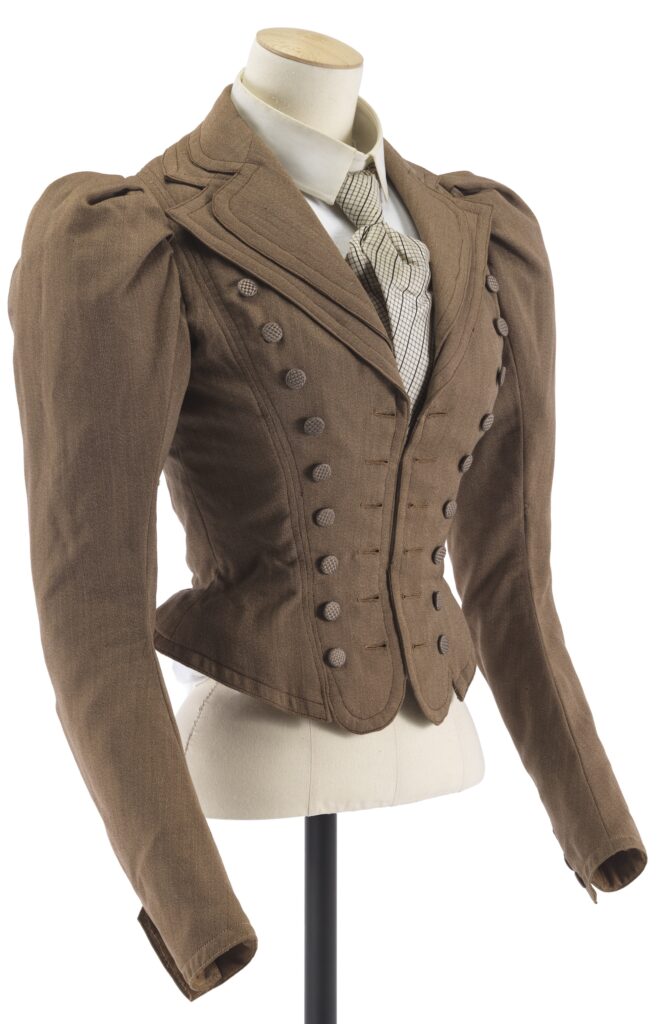
Riding habits, tailored suits, cravats, bow ties, top hats and more dialogue with a selection of paintings, fashion plates, and one hundred-and-fifty never-before-exhibited amateur photographs (most of them from the Lesbian Herstory Archives in New York), offering a plurality of gazes on a moment in history which had yet to be explored.
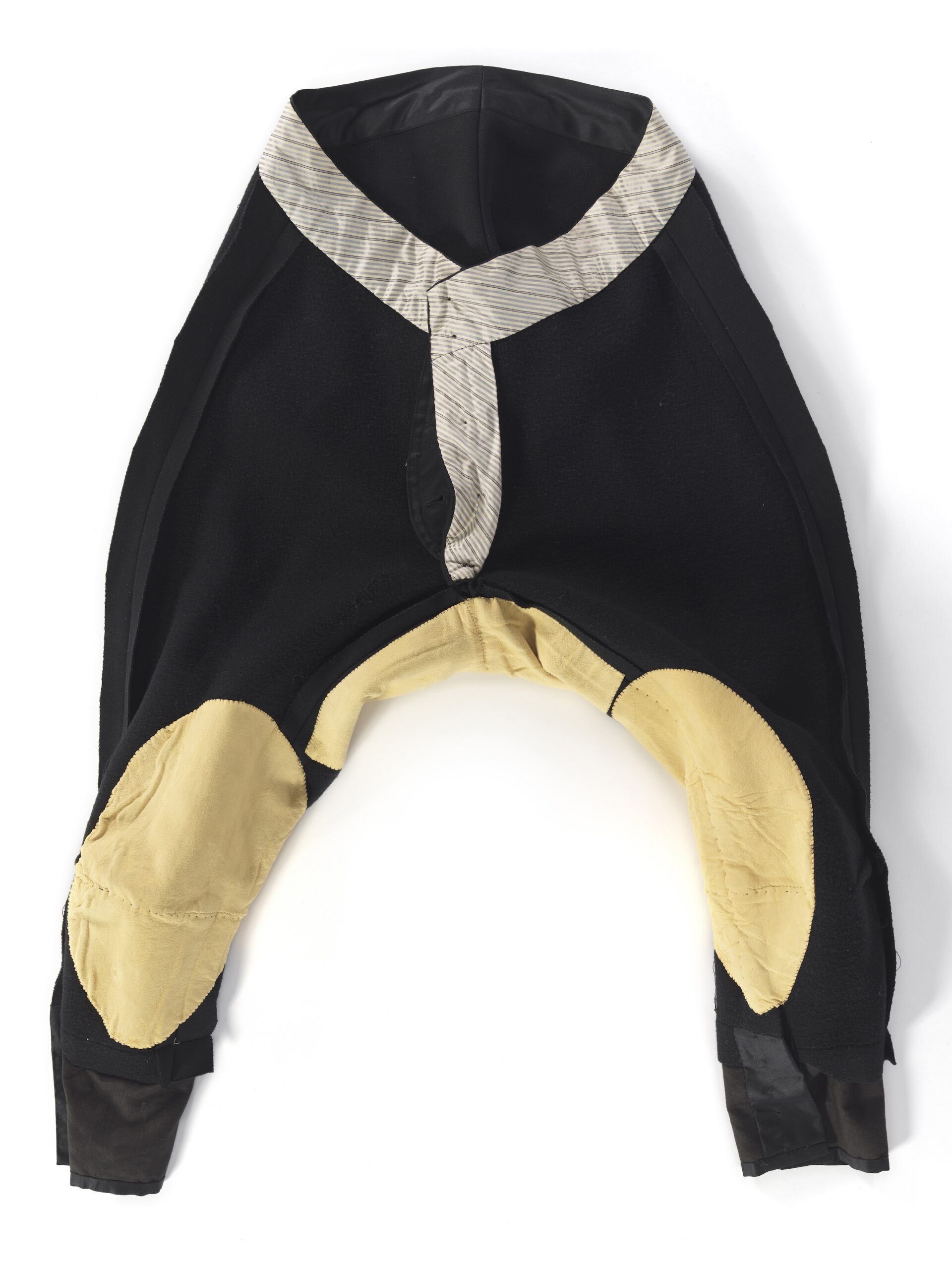
The proximity of male and female dressing starts with the riding habit, and the exhibition displays its evolution to argue how central its transformations were for the development of garments such as trousers. Emancipation was also a sartorial matter, debated in the press, in court and on the streets, as it involved bodies who moved, desired and demanded equality more and more.
Military-adjacent accessories and styles were also adopted by women: unwillingly or willingly, to participate in battle, to assert non-conforming identities through the appropriation of typically masculine visual elements, but also simply to turn symbols of male fighting power into fashionable details of ornate dresses and frock coats.
The female tailored suit marks the ultimate realisation of this convergence – a style that demanded respectability and legitimacy while shaking the foundation of the era’s patriarchal social order.
The subjectivities involved in the exhibition are plenty: from the flâneuse – the turn-of-the-century emancipated woman – to working women, who borrowed the trousers early on for practical reasons, up to lesbians and non-conforming identities, which found in adopting male sartorial tropes as means for gaining the agency which was stripped from them by lapidary societal norms.
The exhibition also displays a previously unseen collection shown in its entirety: a true “wardrobe of one’s own,” which belonged to artist Rosa Bonheur, the first woman painter to receive the legion d’honneur, and also the bearer of a permit to wear trousers as those were part of her work uniform. This collection embodies the conscious, deliberate and intimate sartorial choices which subtly yet radically challenged gender norms and their clothing conventions, underlining the role played by material culture in the construction of individual identities.
Another unique item is an ensemble worn on stage by Vesta Tilley, one of the most important male impersonators, who enjoyed extreme popularity at the turn of the century between the UK and the US. It is the first time the look leaves its home in Worcester to represent the importance of the stage as a territory where things that were policed in real life (as crossdressing) could indeed lead to success and fame.
This theme is also explored in Dandykes (6’, 2026), a short film created for the exhibition in collaboration with artist and art historian Hortense Belhôte.
Sartorial ambiguity, visual tensions, semiotic clashes and correspondences are also the traits of the exhibition’s scenography designed by klapisch•scénographes, where labyrinth-like structures, mirrored figures and bold palettes refrain the themes of transformation and rupture of dissident femininities.
The exhibition – which opened September 26th 2026, and will remain on view until February 14th 2027 – conveys a simple yet crucial truth: be it of a man, woman, child or person, wardrobes are testimonies of political, societal, and personal trajectories. Studying these collections – their build-up, stratification, hybridisation and transformation – can unveil collective narratives which still echo today.
Exhibitions 16.09.2026
Fashion & History 12.08.2026
EFHA World 17.04.2026
Designers 12.03.2026