European Fashion Heritage Association

Journal → Designers

Roberto Cavalli: an ode to embellishment

15.11.2026
fashion designerRoberto Cavallirunway archive

A guest post by Alexandre Zamboni, who selected three objects from the EFHA archive to honor the designer’s enduring legacy

Roberto Cavalli certainly did not wait to go to heaven to create his paradise. On November the 15th, the Florentine creator born in 1940 would have turned 86, and his life was a quest for beauty indeed. Cavalli channeled his sensitivity into art from an early age, probably inherited from his grandad, the macchiaiolo painter Giuseppe Rossi (1876-1952).

Long before his brand officially launched in 1970, Cavalli experimented with placed prints on fully fashioned knitted pullovers in the 1960s. The idea came from his studies at the State Institute of Art in his hometown – where Cavalli discovered his talent for color, textures, and motifs in the textile print atelier, giving rather banal clothing pieces a soul and a story, as a painter does with a white canvas. Following those years of experimentation, he played all of his life with materials, treating pieces of leather and denim as mosaics, embroidering and enriching any surface in a never-ending pursuit of beauty in its most maximalist form. It was an almost obsessive love of decoration, a true horror vacui, that became the signature of an artist. 

To celebrate his birthday and honor his legacy, we asked Alexandre Zamboni, fashion researcher, archivist and true Cavalli connoisseur, to select three objects from the EFHA archive, each telling a chapter of this hedonistic journey.
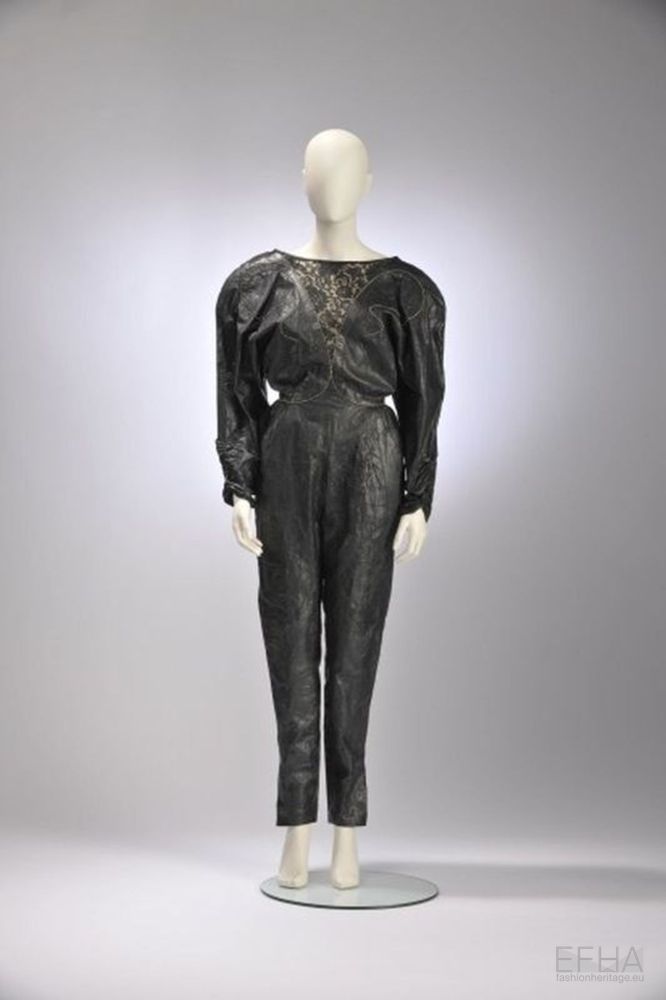
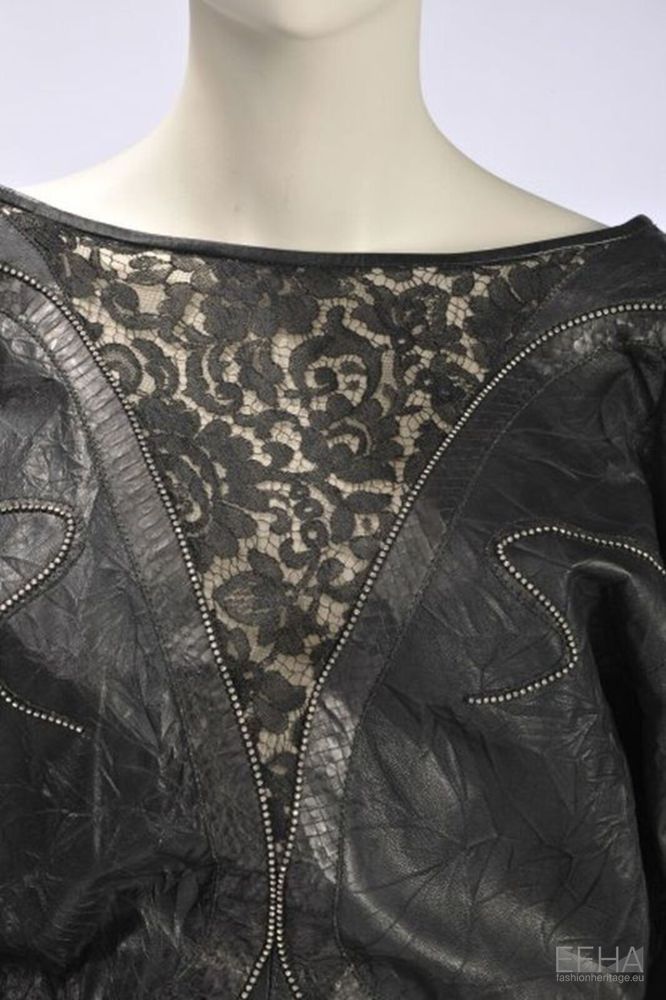
Following the successful early years of his presentations in the Sala Bianca of Palazzo Pitti in the 1970s, where Cavalli became known for refined leather ensembles printed with Art Nouveau and folk-inspired motifs, the late years of the decade and the early 1980s brought a change of scene. The Italian fashion industry was gradually moving to Milan, and the prêt-à-porter boom was underway, but Cavalli stubbornly refused to scale up his business, keeping it artisanal and based in Florence.

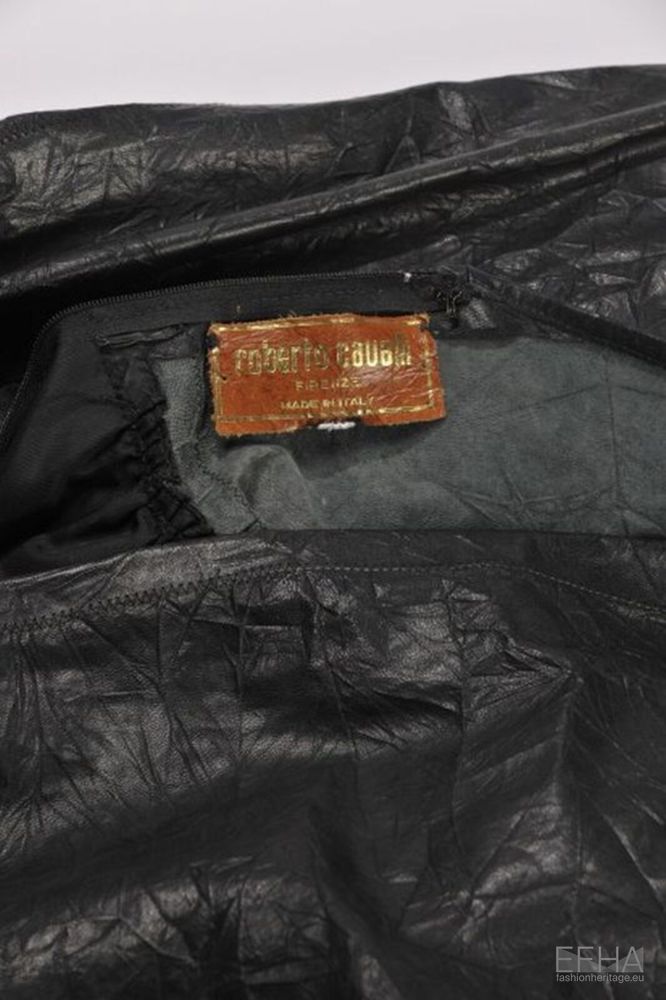
This jumpsuit, probably from 1985 or 1986 and now kept at the Modemuseum Hasselt, is an example of his work during those years. As he abandoned the bohemian influences of the previous decade, a more glam-rock approach to dress began to flourish, with a juxtaposition of crinkled black leather, lace and details of snakeskin, all decorated with rhinestones that give the silhouette a graphic edge. This abundance of detail reflects Cavalli’s refusal to simplify his pieces in the name of functionality, preserving the crafty flavor of his early collections. A hint of what was yet to come can be found at the back, where a plunging neckline reveals a penchant for flesh display that would later become one of his hallmarks.

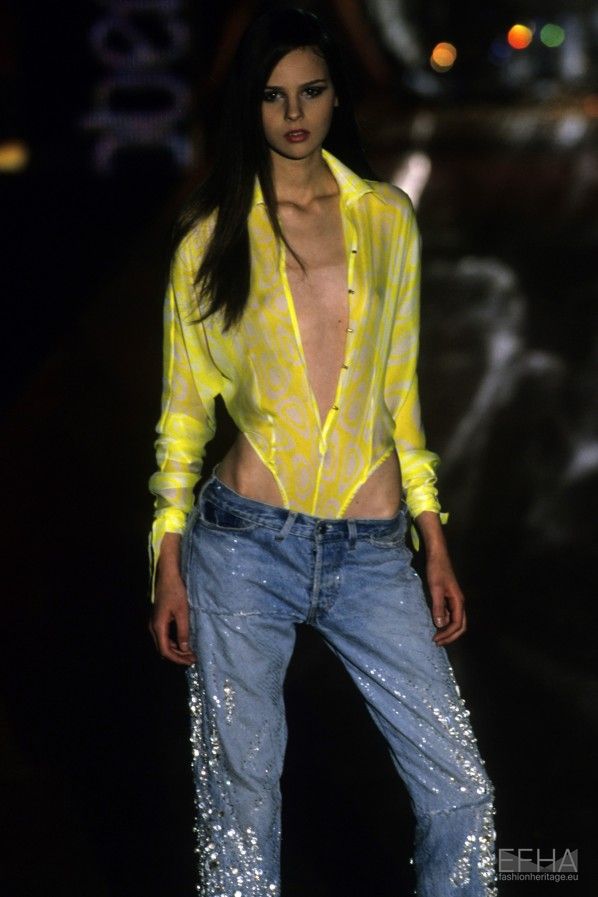
As the 1990s started, Cavalli declared he was no longer inspired by fashion, preferring to focus on his growing family and his horse stable – a flourishing business that kept him busy throughout the 1980s. His second wife, Eva Maria Düringer, had taken care of the commercial side of the company. It was she who insisted on exploring materials once again to renew the fading fashion brand. It took a pair of sandblasted and printed stretchy jeans to launch a revival in 1994. Denim then became not just a material to use for psychedelic patchwork, but a canvas for Renaissance and baroque motifs, chinoiserie flowers and, of course, animalier prints, especially snakes and reptiles.

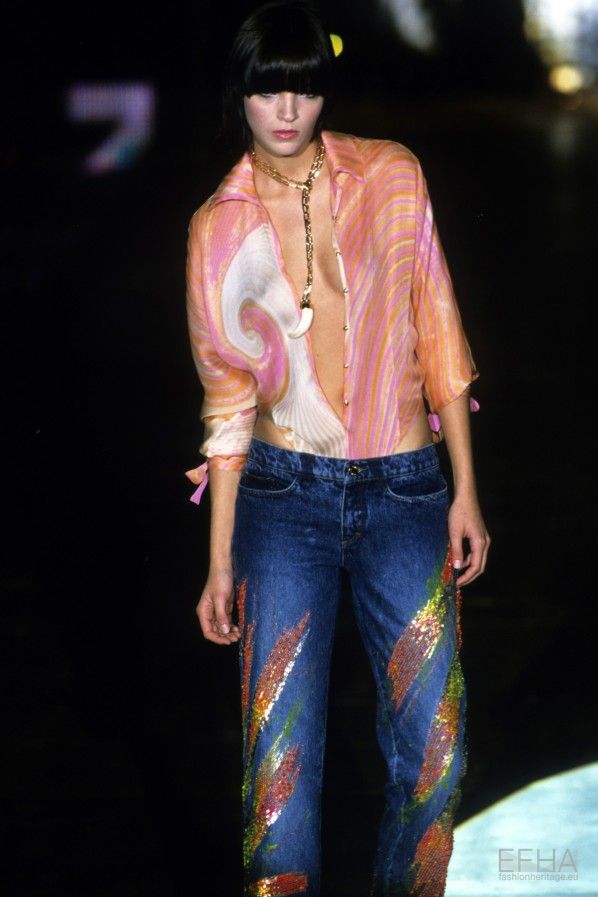
We can say that Roberto and Eva contributed to the birth of luxury denim, with their jeans appearing on the iconic June 1999 cover of Vogue Italia with supermodel Gisele Bündchen doing a capoeira dance – or fight – wearing a pair of heat-applied sequined jeans. From that moment on, jeans became an endless playground for exuberant decoration, with scratches, embroideries and fringes invading their surfaces, as in the case of these flared jeans from the Spring-summer 2001 collection, worn on the catwalk by a young Mariacarla Boscono. Golden paillettes and orange beads break the fabric into unruly flashes of light, giving the jeans a dynamism reminiscent of Giacomo Balla’s Futurist paintings.

If prints on leather and denim reflected the almost primitive instinct of Cavalli to decorate objects, it was on silk mousseline and satin or twill that the designer expressed his most elaborate patterns and opulent drawings. This was certainly a heritage of his early visits in the 1960s to the renowned Como textile printers, who taught him the secrets of the craft. In the mid-2000s, his fashion became synonymous with glamorous and sensual gowns, also thanks to vibrant and abstract prints, often the result of pictures taken by the designer all over the world, as shown in the book “Il nero non è mai assoluto” (Italian for “black is never absolute”, 2010), a collection of digital photographs portraying animal skins, exotic plants, desert dunes, candies and the neons of the city – with a preface of Franca Sozzani.

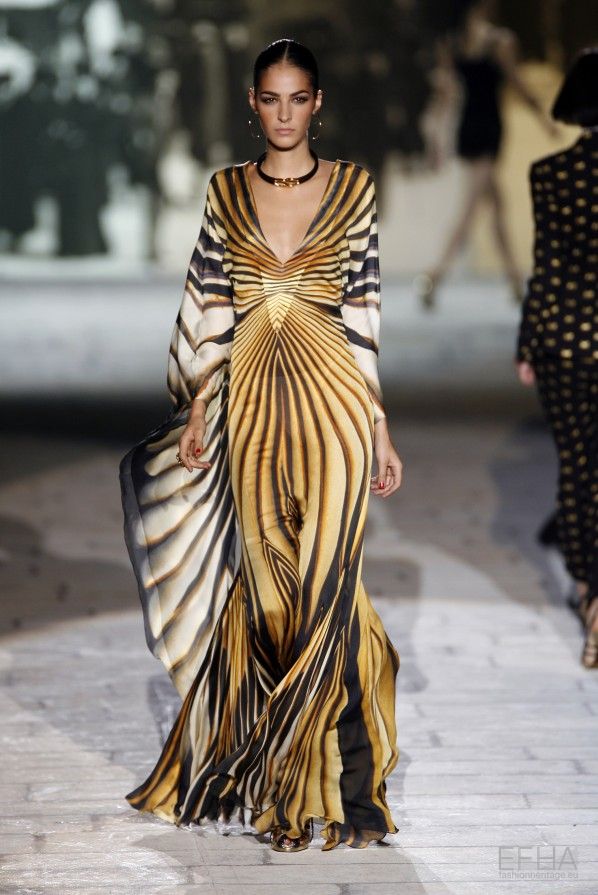
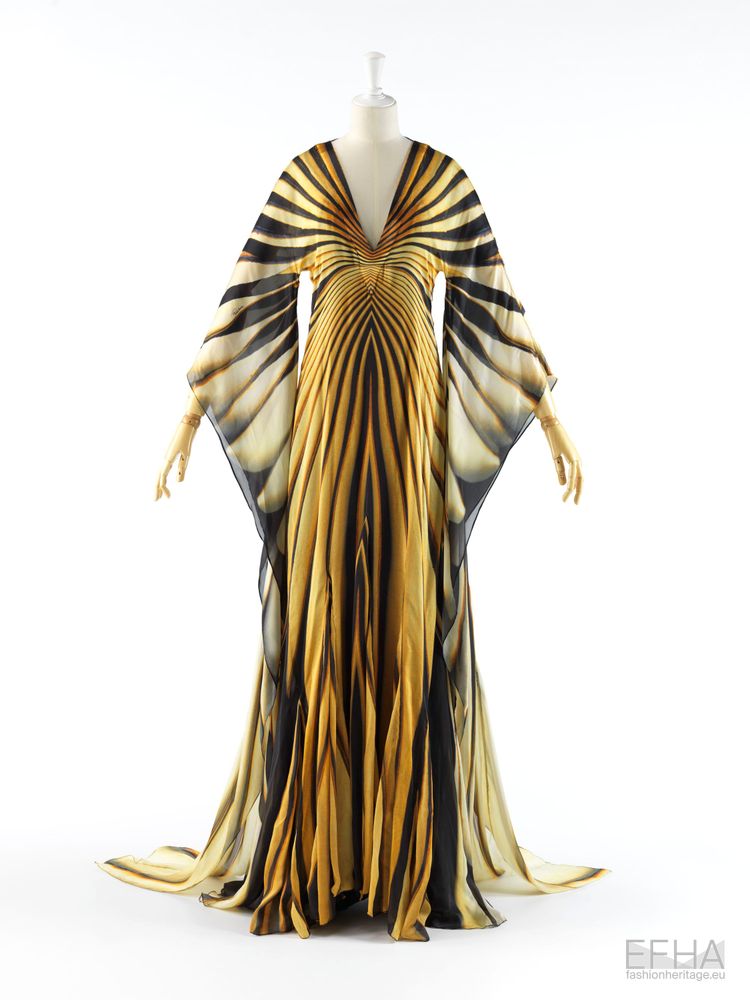
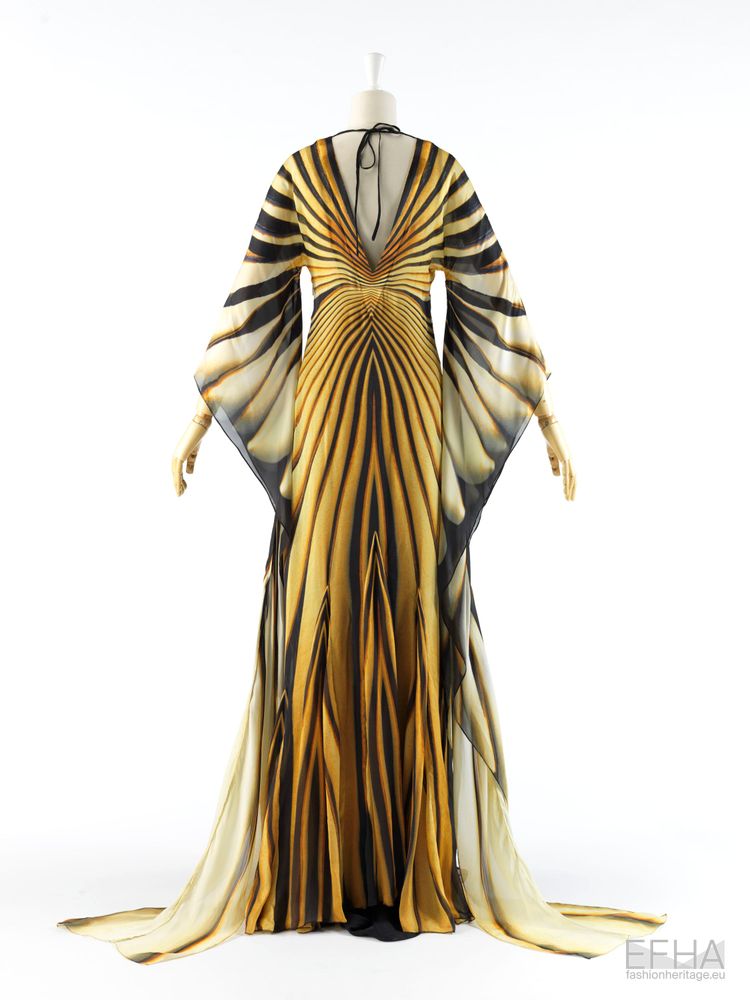
In this famous dress from the Spring-summer 2007 collection, a donation of Jacqueline, Comtesse de Ribes, to the Palais Galliera in Paris, the print, known as the Ray of Gold motif, dictates the shape of this long gown with gothic medieval sleeves and deep V necklines. Here the print does not decorate the dress; it constructs it. The motif might be a zebra print; it looks like an insect but also like the lines of a shell. The viewer has to decide; the artist only suggests.