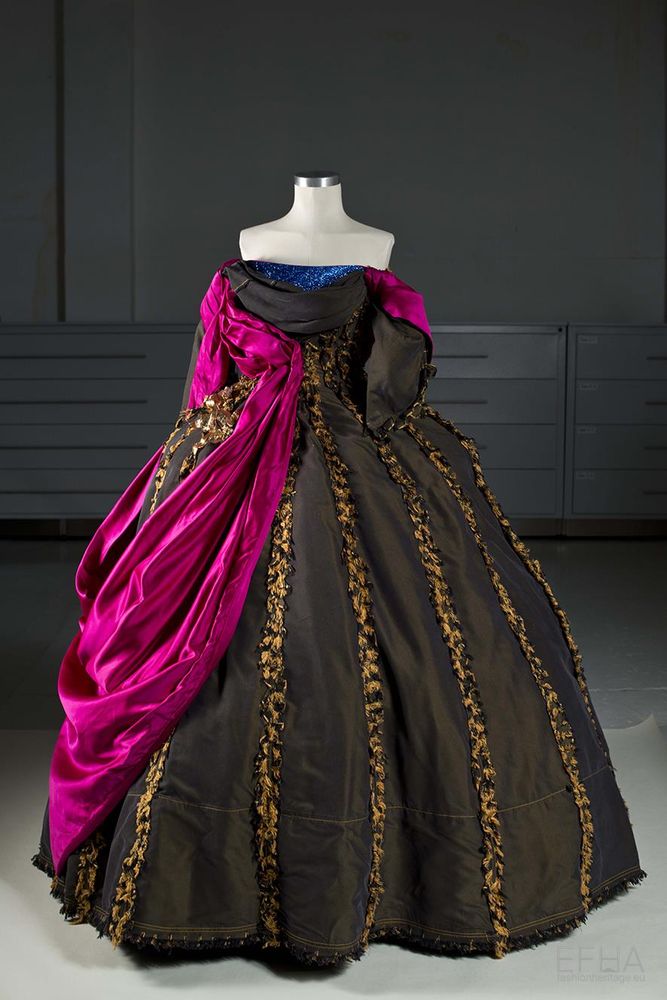
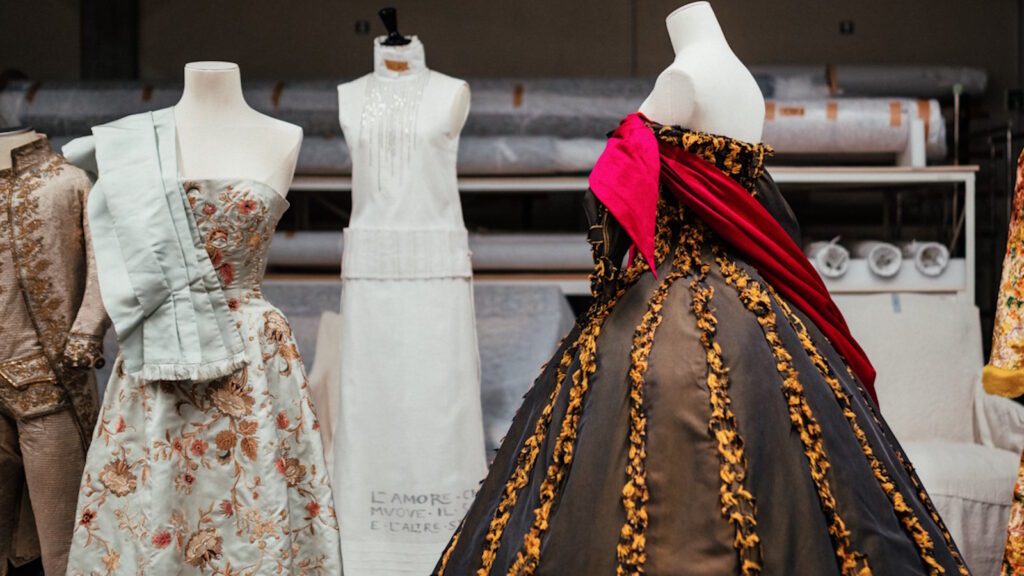
Bárbara Coutinho, the director of MUDE – Museu do Design, reflects on the museum’s role in the “Art & Fashion” exhibition, presented at the Calouste Gulbenkian Museum. MUDE contributed with 38 pieces from its fashion collection and worked closely with curator Eloy Martínez de la Pera Celada. In this interview, Bárbara Coutinho discusses the collaboration between institutions, shares the work of MUDE’s team across research, selection, installation and photographic campaign processes, the importance of including portuguese designers and the impact the exhibition has had both on visitors and the museum itself.
We would like to start by understanding what this experience was like for you and the MUDE team, was it a project you enjoyed collaborating on?
Contact with MUDE was initiated by the Calouste Gulbenkian Foundation, through Jessica Hallett, deputy director to Filipe António Pimentel. My first meeting with the curator, Eloy Martínez de la Pera Celada, took place two years ago. He asked whether I could prepare a brief presentation of our fashion collection, and I did — directing him at the same time toward Europeana and EFHA, and sharing my views on pieces I considered essential. He then began his wider research, contacting other museums, private collectors, and institutions. About a year later, he returned with a preliminary selection larger than what was ultimately shown at Gulbenkian. We are the main lending institution, with 38 pieces; his initial list, if I recall correctly, exceeded 50. That selection was reviewed on two fronts: by the conservation team — Inês Correia and Inês Matias — who assessed each piece’s condition, recent exhibition history, and capacity to travel; and curatorially, by Anabela Becho, MUDE’s fashion curator. Several meetings followed, including one held directly in the storage reserves, where pieces were unpacked and examined alongside the curator. Our role throughout was to provide the information he needed to make his final decisions; the curatorial authorship of the exhibition remained entirely his. One aspect I find particularly significant — and which I tried to address in the catalogue text I was later invited to write — is the inclusion of Portuguese designers. When I first met Eloy, Portugal Pop was on view at MUDE, tracing fifty years of national fashion history; he was able to visit it, and given Gulbenkian’s location in Lisbon, integrating Portuguese voices into the selection mattered to him. The final exhibition includes work by Maria Gambina, Nuno de Gama, Storytailors, Joana da Béhen, and Alves e Gonçalves, with Tenente also represented through another lender. This presence carries a dual significance: it introduces Portuguese production to an international audience — the catalogue is published in both Portuguese and English — and it directly supports our institutional mission to study, promote, and internationalise design from this country.
The second major phase of involvement was the installation itself. The photographic campaign preceded the opening by several months; pieces were sent to Gulbenkian in advance, and the campaign for the MUDE collection alone ran for nearly three weeks, supervised throughout by our conservation team. The installation that followed was technically demanding — some pieces complex in scale, others in material, others in the particular challenges of cut and silhouette. It was intensive work, but also genuinely rewarding. Being part of an exhibition of this level, alongside international lending partners, has already generated further momentum: conversations with the Museo del Traje in Madrid are ongoing, with co-productions and collaborative initiatives under discussion. This was, in the end, a moment that brought art and fashion into serious dialogue — and one we are very glad to have been part of.
Precisely picking up on the theme of art and fashion: from the very beginning, when you were contacted by the Foundation, was this already the idea for the exhibition?
The idea was there from the very beginning. In fact, the choice of curator itself already implied that focus. The curator is known for several exhibitions — notably on Balenciaga and Givenchy — and for a very particular aesthetic approach in his selections and curatorial work.
From the outset, the intention was to place art and fashion in dialogue, because Gulbenkian himself — or the Gulbenkian family — had that sensitivity. And I also believe that the growing attention major international museums have been giving to this relationship played a role: museums have increasingly been looking at fashion as an art form and integrating it into dialogue with their permanent collections — the Louvre being one example. That likely helped frame the choice. But the theme had been defined from the start.
This was also something we were wondering about — whether the dialogue between art and fashion was built simultaneously throughout the process, and also how this visual and conceptual dialogue was established between objects with such different functions and contexts.
Everything related to the curatorial choices belongs to the curator himself. But from what I was able to observe, it clearly began with direct knowledge of and contact with the Gulbenkian collection. What comes from outside is the fashion. What is already at Gulbenkian is the collection that is usually on display in the long-term or permanent exhibition. So Eloy certainly established these parallels from the very beginning, as can be seen in the exhibition itself: formal parallels, aesthetic and technical parallels, sometimes based on motifs or symbols. Some dialogues are based more on formal characteristics, others on cultural references, and others on symbolic or technical elements. You begin by saying: if I have this collection, then I will look for pieces that dialogue with it. He never explicitly told me this, but putting myself in his position — as someone who has curated several exhibitions myself, some also exploring the relationship between art and fashion, such as Baixas Fronteiras in 2016 with the Museu de Arte Contemporânea in Elvas — that is usually the process. We start from the reality of the collections. In the case of Elvas, for example, I knew our collection and then studied the MACE collection, and from there, through visual culture and research, I began identifying artists with affinities, readings I wanted to bring together. So normally that is always the process behind constructing any exhibition. Here, it seems to me — and from what Eloy writes as well — that it began with the Gulbenkian collection, understanding it deeply, and then discovering an entire constellation of pieces that, for various reasons, could be read in relation to this “mother collection.”
How did your own selection process work?
The selection was entirely made by Eloy. What we provided was guidance. Guidance in the sense that, first, he had access to everything that was digitized in our collection. So he chose from that base. At a third meeting, he brought the artworks that he intended to place in dialogue with the fashion pieces — paintings, for example. Perhaps we suggested one or two things, but even if we had suggested more, the decision was always the curator’s. What we did was provide technical consultation as the people who know our collection best. It was more a matter of assisting his process: “I need to work on these themes — what options do you have?” And then he would also look at the other options he had from other places, other museums, and other studios and fashion houses that had also loaned pieces here.
We saw several photographs of MUDE’s team during the installation process. Could you talk a bit about that process?
It was a very challenging and demanding process. I myself was not able to follow it closely because of everyone’s work responsibilities. It was followed much more closely by Inês Matias, by Anabela Becho, who dressed many of the pieces, and by the rest of our team. And it really was very demanding. I can share what emerged in conversations with Inês Matias and the others: dressing a piece is always a fascinating process for understanding how it communicates, but also for studying better ways to preserve it. By dressing it, handling it, and observing the transformations the piece undergoes, we learn more not only about how to exhibit it, but also about how to store and preserve it. So it was a great “orchestra.” I use that word because every time I visited the installation, that was the feeling I had. It was an orchestra involving various teams from different museums, conservation teams who came to dress their own pieces, and Gulbenkian’s own teams. And within that shared space of placing such different objects in proximity and dialogue — while preserving their safety and simultaneously creating new interpretive possibilities — the process was challenging, labor-intensive, and enriching. I would say those are the three words that best characterize the installation process.
Although it is a short-term exhibition, it has had a huge turnout and become very popular. Have you heard anything about visitors’ feedback?
What I have mostly heard from people I know is that the exhibition is very visually appealing and evocative. You can clearly see that from the images. At the same time, I have also heard recognition of the value of the fashion pieces. And, in a certain sense, even some surprise at understanding the richness of our collection and everything that has been brought together there. I think the response has been overwhelmingly positive and very favorable toward the exhibition. The feedback has genuinely been very positive. And I think it is wonderful that these exhibitions are designed in a non-elitist way and bring together so much.
So I think both the catalogue and the exhibition are significant. The catalogue will have a long life. The exhibition will be shorter because of practical realities. But I hope more and more people will see it and fall in love — or fall in love again — with both art and fashion.
Is that what you hope visitors will take away with them?
Absolutely.
Would you like to have more projects like this?
We have actually been involved in similar collaborations. For example, several Castelbajac pieces from our collection are currently in the exhibition he organized in Marseille, which is still on display.
Other pieces are also at the Museu do Chiado. Two Maria José Oliveira pieces are currently there. So these collaborations between institutions do happen, and they represent the richness of our collection and our work very well.
Of course, in the case of this exhibition, what made it unique was the sheer scale of the loan. That level of involvement is unusual, which is why Gulbenkian acknowledged us with the phrase “with the special collaboration of.” So the exhibition is presented “with the special collaboration of MUDE and Museo del Traje Madrid.” That does not mean there were no other loans — there certainly were — but MUDE and Museo del Traje Madrid were deeply involved throughout the process and the selection. That acknowledgment allowed me to express what I think is most important. And on top of that, the cover of the catalogue also features one of our pieces. So the book cover has this special quality of combining a Gulbenkian painting with a dress from our collection. And I think this is truly an important moment in the work of our museum and of the various teams within it.