
EFHA World 20.10.2025
12.08.2026
craftEuropean fashionfashion heritage
The collector and ethnowear designer shares the artistry, symbolism and memory held within traditional embroidered shirts – and the responsibility of fostering their value for the future.
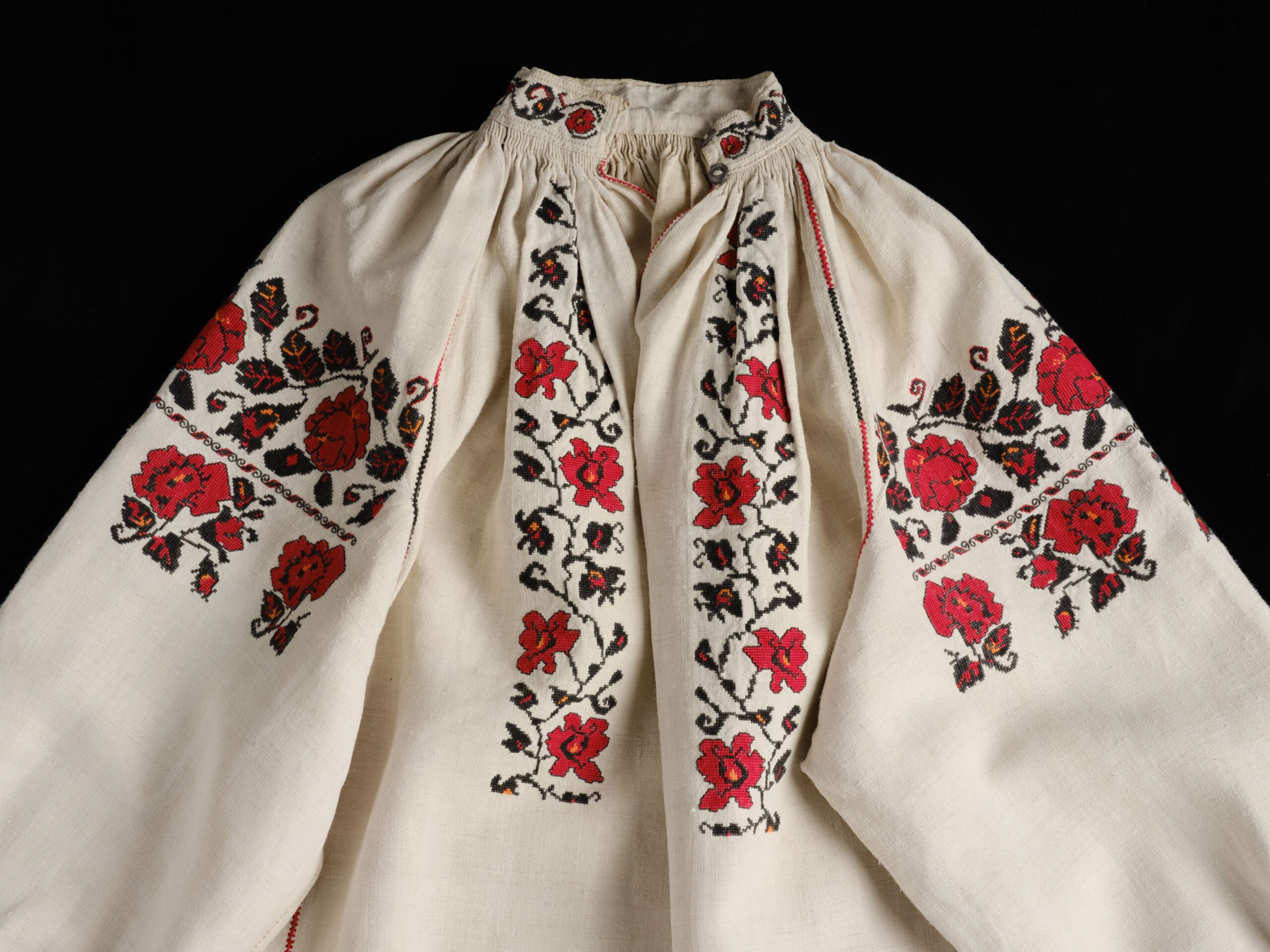
Khrystyna Rachytska is a Ukrainian designer, collector and passionate advocate for the preservation of traditional dress. Through her work, she brings together the worlds of fashion, craftsmanship and cultural heritage, drawing on centuries-old regional embroidery techniques and traditions to create contemporary expressions of the Ukrainian identity. Alongside her design practice, she has spent more than twenty years building a vast collection of Ukrainian embroidered shirts, each offering a glimpse into the artistry, history and everyday lives of the women who made and wore them. Through both her collection and her designs, Rachytska continues to explore the enduring relevance of Ukrainian textile traditions.
What inspired you to start collecting Ukrainian embroidered shirts, long before you knew your effort would grow into one of the country’s largest private collections?
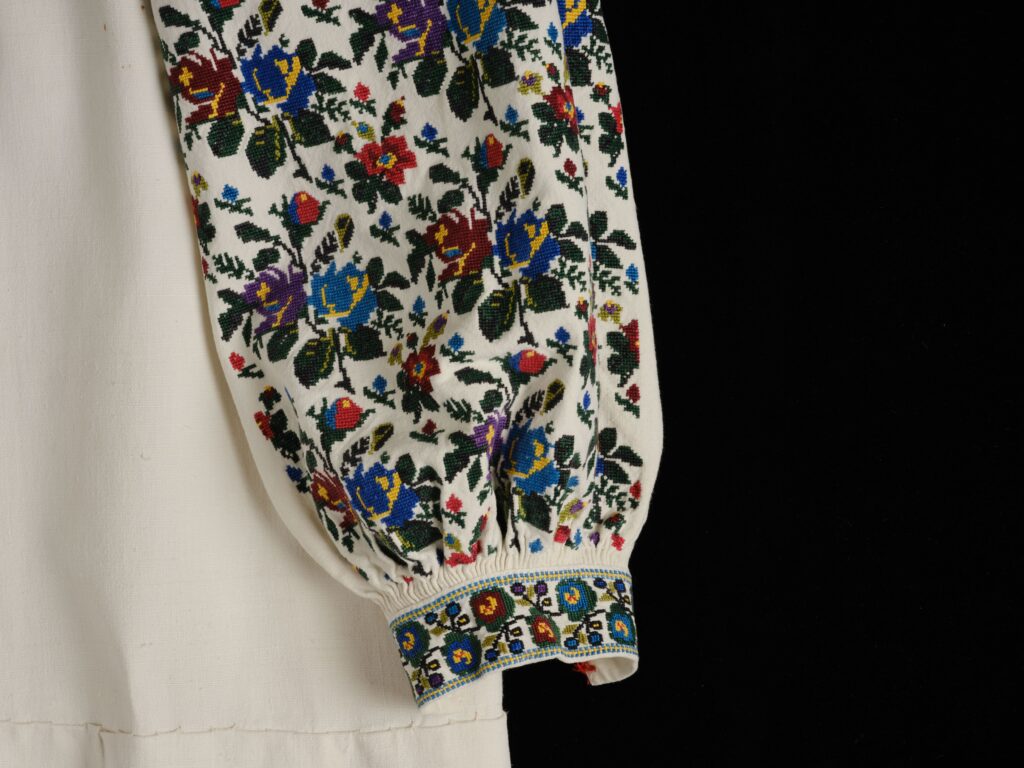
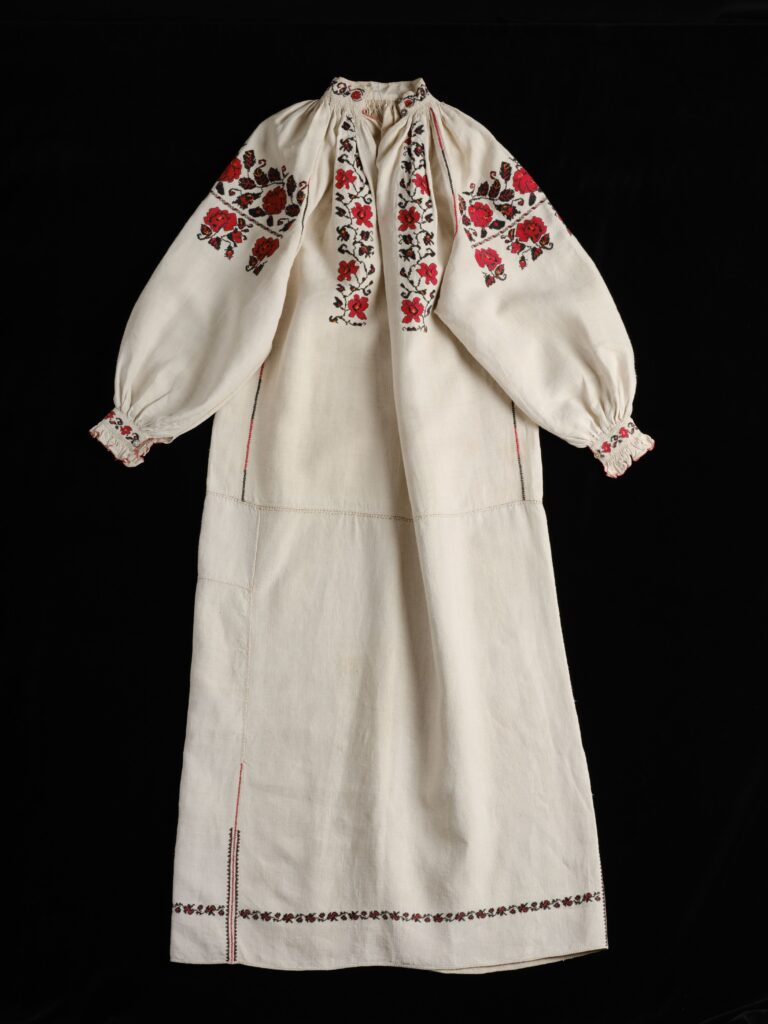
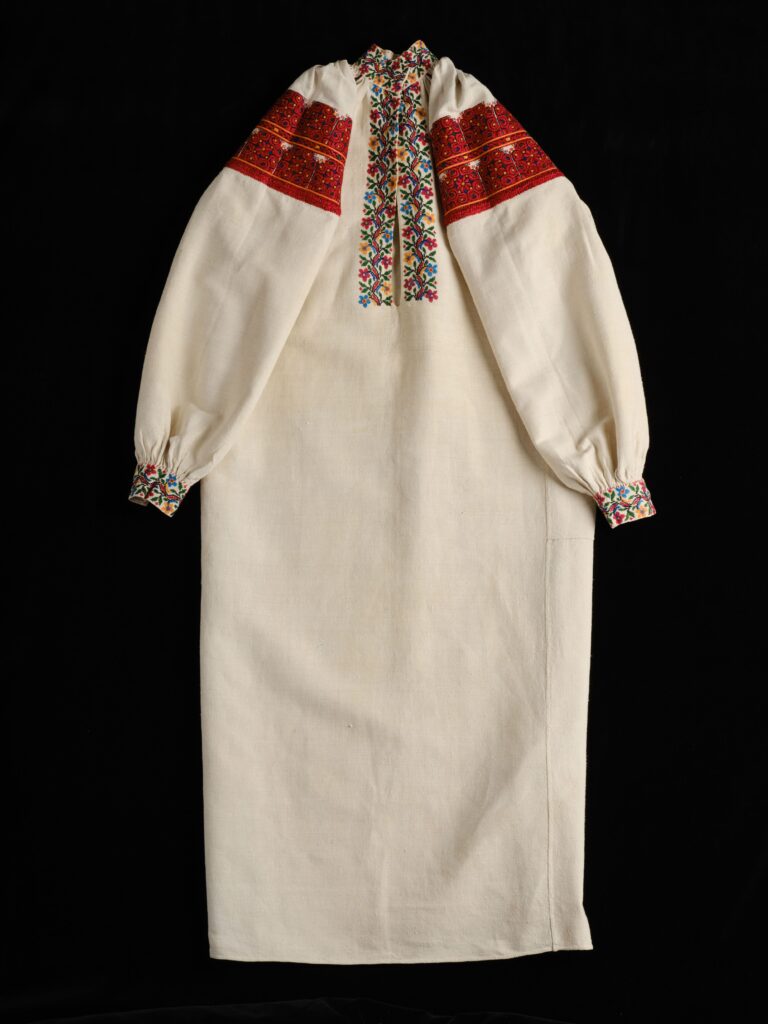
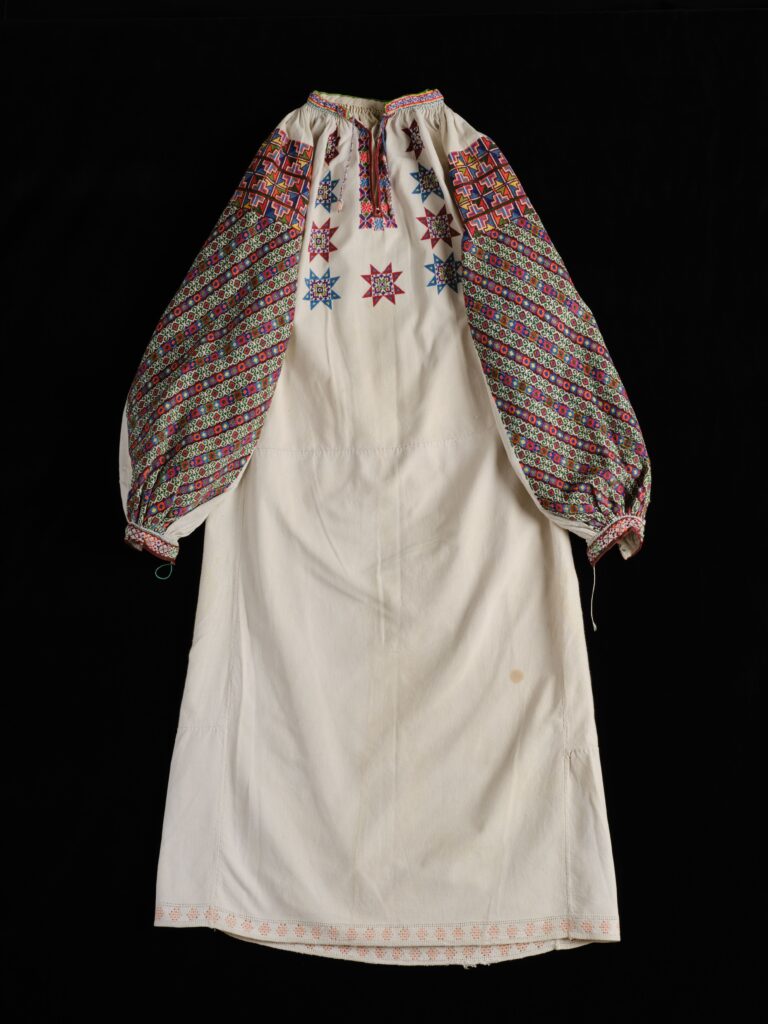
I never really set out to build a large collection. I was around twenty, studying design at the Academy of Arts, when I started collecting the pieces. At that age, I certainly did not fully understand the scale or importance of what I was beginning to do – I was simply a student who wanted to learn. The academy library had only a couple of books inherent to traditional dress, so I started looking for physical examples myself for research purposes. At first, I collected small fragments of old embroidered shirts – cuffs, collars, shoulder inserts– so that I could see the embroidery up close, hold it in my hands and understand how it had actually been made. What fascinated me was the extraordinary artistic intelligence of Ukrainian women: their command of the needle, their sense of proportion, color and composition. These shirts are, quite simply, works of art. There are no two identical ones.
Later, when I could afford to buy complete shirts, I would often spend my entire scholarship on them. To me, each one became a kind of textbook. I could study the embroidery, learn the techniques and try to understand how women, without electricity, the internet or the conveniences we have today – while raising children and managing enormous households – were able to create such refined objects. The collection grew gradually from that curiosity. I never had a target number in mind, and for many years I did not even think of it as a collection. Collecting has its own kind of momentum: you find one object, then another, and every discovery makes you want to understand more though further findings.
What is the mission behind the collection, and is it physically accessible to the public?
The most important thing for me is that these shirts remain in Ukraine and available to Ukrainians. Over the years, I have found Ukrainian shirts in different countries– pieces that had been taken abroad, sold or left behind – and whenever possible, I tried to bring them home. This is our heritage, and I believe its place is here. At the same time, I would love the whole world to fall in love with Ukrainian embroidery, because there is so much for us to be proud of. Access is therefore very important to me. I never wanted the shirts to become something distant, hidden away behind glass.
The space in Lviv was conceived as a place where people could see them up close, experience them first hand and, where possible, have a more direct relationship with the objects. The next major step is digitization. I want the collection to exist beyond the physical space in Lviv: photographs, descriptions, stories, videos and eventually a virtual environment where someone who cannot travel to Ukraine can still study the shirts and learn about their histories.
What was the process of building a museum-like space to host the objects? Did you consult museum conservators, textile specialists, or conservation literature?
When creating the space, the practical conditions came first: lighting, ventilation and the systems necessary to keep the textiles stable. I did not rely extensively on external consultants because my own education is closely connected to the subject. I trained as a garment constructor and technologist, studied materials science and have spent many years working professionally with textiles. At the same time, I was incredibly fortunate to meet representatives of the older generation of Ukrainian art historians and museum specialists while they were still alive – people who had helped build important museum collections in Lviv and Kyiv and had shaped the field of Ukrainian art history itself. Looking back, I understand what a privilege it was to listen to them.
I am also still in contact with people I think of as custodians of museum and heritage science, and when necessary I ask for their opinion or advice. Conservation is constantly evolving. Once standard methods are now being replaced by new technologies and processes, so there is always more to learn. Over the years I have also developed my own very practical knowledge: how to wash and clean the shirts, protect them from mould and insects, use ozone and ultraviolet treatments, and even store certain wool-embroidered pieces in freezers when necessary. During the summer, the collection is aired and dried carefully, always protected from direct sunlight. Caring for it has become an enormous part of my life.
What cataloging system do you adopt?
The cataloguing is still a work in progress. For each shirt, I record as much provenance as I know: the region, the village, where it was purchased, and, when that information survives, whose wardrobe or family it came from and who originally owned it. What I have not yet completed is a formal museum-style numbering system, with individual inventory numbers or accession codes for every object. That is something I am currently developing, and I will most likely need the help of someone with museum experience to structure that part of the archive properly.
At what point did preserving the garments become just as important as collecting them?
For me, preservation was there almost from the beginning. I never really thought of the process as collecting for the sake of collecting. I felt that certain shirts simply needed to be rescued and preserved. Many had disappeared from Ukraine – families emigrated and naturally took them as memories of home. Others remained here, but were no longer understood as valuable objects. I have found exquisite shirts that had been turned into sacks, used for household work or even used to wipe floors. Some were stored or forgotten in barns simply because no one understood what they were.
In my mind,collecting and preserving were never separate things. The point was to save what could still be saved and give these objects the value and care they deserved. Today, I also embrace the conscious decision not to erase the life of an object through restoration. I do not try to make every shirt look new. A stain, a hole, a broken thread is part of the object’s biography. Just as our bodies acquire traces of our lives, these shirts do too. I want to preserve them as honestly as possible, in the condition in which they reached me.
In what ways does the act of collecting inform that of designing new clothes?
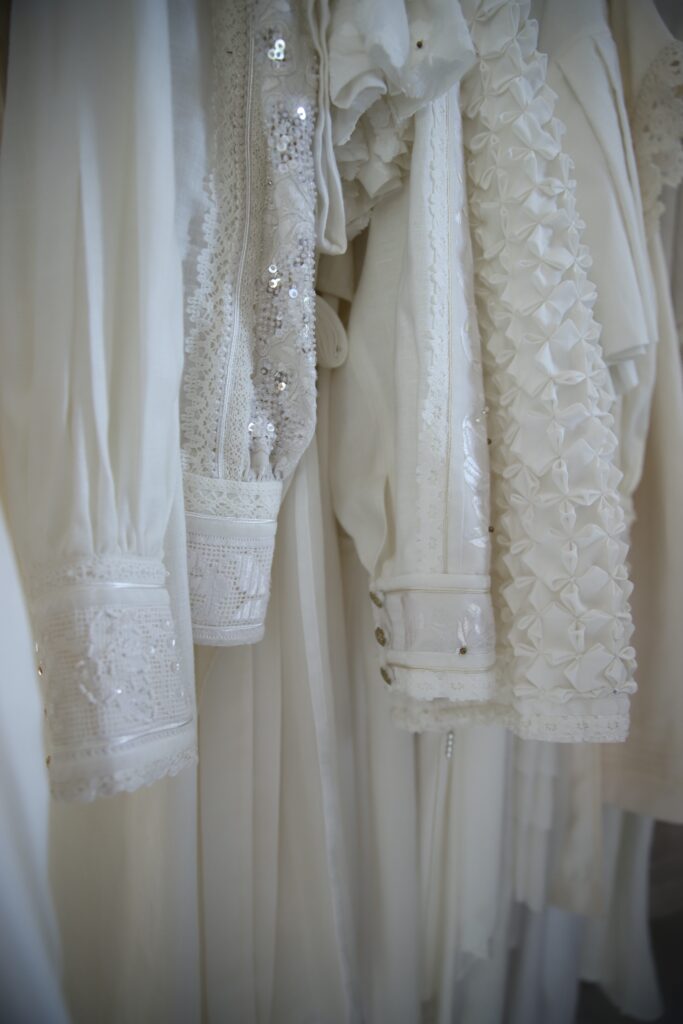
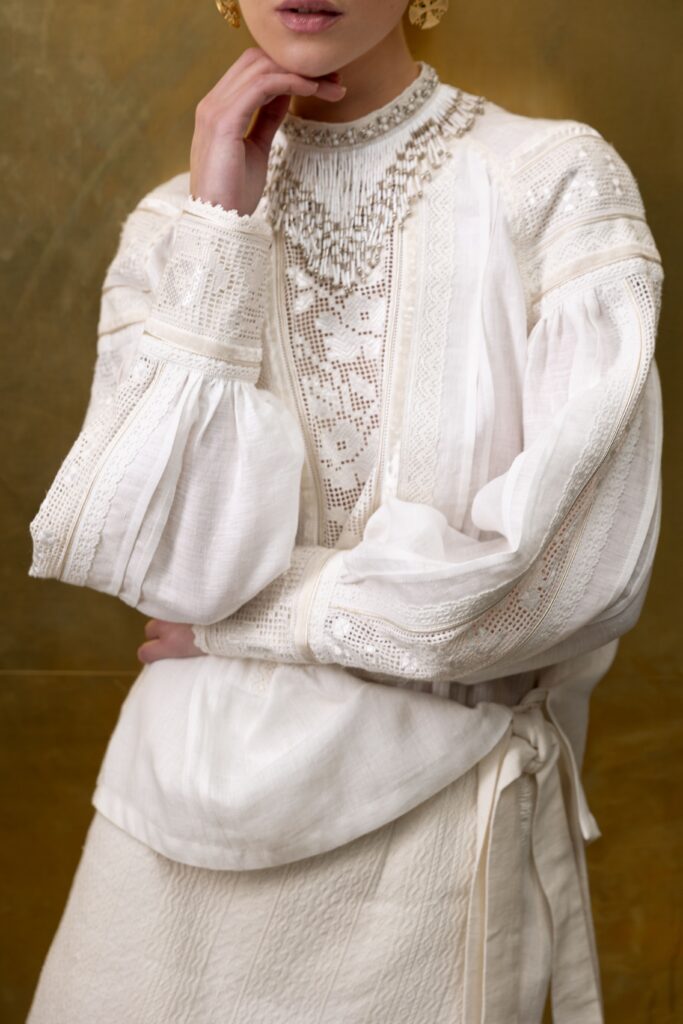
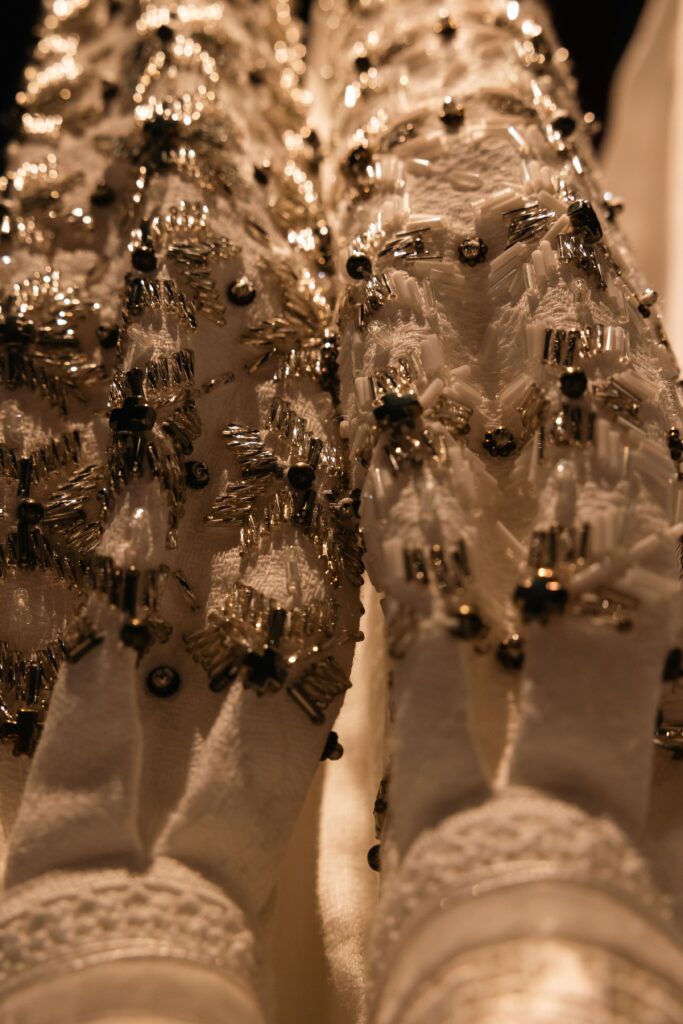
The shirts influence me first as a person and only then as a designer. They shape my inner world, my understanding of myself and my identity. Through them, I enter the lives of women who lived before me– my grandmothers’ and great-grandmothers’ generations– and,naturally, all of that eventually appears in my work. There is also a very literal connection between the archive and what I design. Over the years I learned many of the embroidery techniques myself, and began reproducing historical embroidery patterns as faithfully as possible. We can still work with DMC threads, for example, whose history goes back to the 19th century and which Ukrainian women themselves used when imported threads began reaching Ukraine.
My aim is not to redesign the historical pattern but to reproduce it as closely as possible and allow it to enter contemporary life. In our modern garments, I have also developed the embroidery so that it can be removed from one piece and transferred to another. Bodies change, clothing wears out, pieces are passed from one generation to the next. The fabric may eventually need replacing, but the embroidery can survive. I love the thought that a century-old pattern could live for another hundred years. In this way, the archive does not remain only in one room in Lviv: these embroideries travel around the world with the people who wear them and can become part of other families’ histories.
After studying more than 500 embroidered shirts, what is something about Ukrainian craftsmanship, regional traditions, or cultural history that you found most surprising?
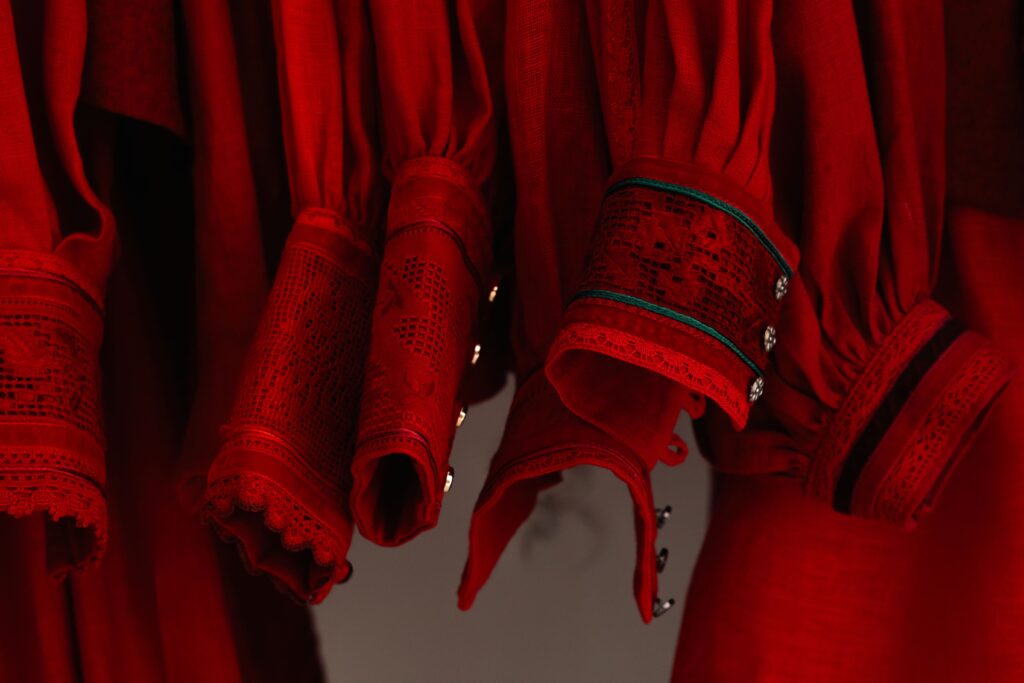
I already mentioned how amazed I am whenever I think about how women were able to create objects of such extraordinary artistic quality. The composition, the color, the symbolism, the materials and the sheer range of techniques are remarkable. From the way someone was dressed, people could understand where she came from – the region, sometimes even the village – as well as aspects of her social or marital status. The landscape itself could enter the embroidery: patterns differed between mountainous areas and lowlands, and changes in climate and vegetation were reflected in the visual language of the shirts.
A shirt was never something quick or inexpensive. Producing one could involve an entire annual cycle – growing and processing flax or hemp, spinning, weaving, cutting, sewing and finally embroidering it by hand.
What has 20 years of collecting Ukrainian embroidered shirts taught you?
It has taught me not to be afraid of these objects – to handle them, study them and care for them without fear of disrupting them. I wash every shirt by hand horizontally; so that the fabric does not fold or strain and the threads do not bleed into other areas – sometimes washing a single shirt takes three or four hours. Some of them bleed color very easily, and learning how to care for them properly has taken years.. After hours over the bath, I often find myself on my knees simply because it is physically easier. I sometimes think of that process almost as a prayer or meditation– a form of respect for the object.
Twenty years have also taught me that there is no single “most beautiful” or “most valuable” shirt. Earlier, I might have overlooked some pieces and thought there was too little embroidery, or that the technique was less interesting. Now, I believe each one has something completely its own, and is therefore valuable.
When you think about the future of Ukrainian cultural heritage, what role do you hope your archive will continue to play?
I want the archive to preserve these objects, of course, but I also want it to preserve the knowledge around them –photographs of the shirts and their details, descriptions, tactile materials people can study, and video materials that can continue to be used in the future. Most importantly, I do not want this knowledge to remain only inside my head or within one physical space in Lviv. My hope is that these shirts remain in Ukraine, that they are passed forward to our children, grandchildren and great-grandchildren, and that people both in Ukraine and abroad can access and understand them.
These objects came to us through generations. Our responsibility is to make sure they continue their journey. Especially now, during the war, I feel that everyone has to act through whatever means they have. My way of doing that is through art, memory and the physical evidence of our culture and identity.
EFHA World 20.10.2025

EFHA World 24.10.2024
EFHA World 10.11.2023
EFHA World 22.05.2023