European Fashion Heritage Association

Journal EFHA World

Woolshed: Reviving Alpine Wool Heritage Through Design and Innovation

12.01.2026
collaborative projectEuropean craftEuropean fashionraw materials

A guest post by Dr Edoardo Brunello and Emilia Gordini on Woolshed, a three-year project promoting cross-border cooperation among Austria, Italy, France, Slovenia, and Switzerland

Woolshed: A New Era for Alpine Wool

In the Alpine valleys, flocks of native sheep have long shaped landscapes, cultures, and economies. Yet today, the raw wool they produce is often seen as waste, a forgotten material that costs farmers more to dispose of than it is worth. The Woolshed: A New Era for Alpine Wool project seeks to reverse this perspective, transforming an undervalued resource into a driver of sustainable innovation and cultural renewal.

Reviving an Ancient Resource

Funded by the Interreg Alpine Space 2021–2027 programme, Woolshed is a three-year project (September 2024 to August 2027) that promotes cross-border cooperation among eight partners from five countries: Austria, Italy, France, Slovenia, and Switzerland. Coordinated by Iuav University of Venice, the project aims to transform what is currently considered waste into a material that is innovative, sustainable, competitive, and circular.

The consortium includes Centro Consorzi (Italy), the Chamber of Agriculture and Forestry of Slovenia, Institute of Agriculture and Forestry Nova Gorica and InnoRenew CoE (Slovenia), Le Textile Lab (France), Impact Hub Vienna (Austria), and Onl’fait and Laines d’ici (Switzerland). Together, these partners bring expertise that spans sustainable design, digital craftsmanship, wool processing, innovation, and regional development.

Mapping the Alpine Wool Ecosystem

The project unfolds through several phases, from mapping the Alpine wool value chain – identifying its strengths and weaknesses – to developing open-source, small-scale technologies designed to be accessible to local enterprises. At the same time, Woolshed promotes collaboration among designers, farmers, artisans, and researchers, encouraging knowledge exchange across the Alpine arc. The project explores multiple sectors, including fashion, design, construction, and packaging, testing new opportunities to use this noble fibre within the framework of the circular economy.

In Italy, and particularly in the Veneto region, the mapping and cataloguing of wool-related actors have been carried out in collaboration with Centro Consorzi. This work provides an in-depth analysis of the entire supply chain, from raw fibre to artisanal and industrial finished products, reconstructing a digital landscape of woolthat connects regional expertise within a wider European framework.

The mapping is accessible online at www.alpine-space.eu/project/woolshed, via the Woolshed Interactive Map in the “more” section. Constantly updated, the map makes visible a network of activities often known only at the local level and allows users to filter stakeholders by activity such as training, wool collection, processing, or product development, facilitating both B2B and B2C collaboration across Alpine territories.

The Digital Alpine Wool Atlas

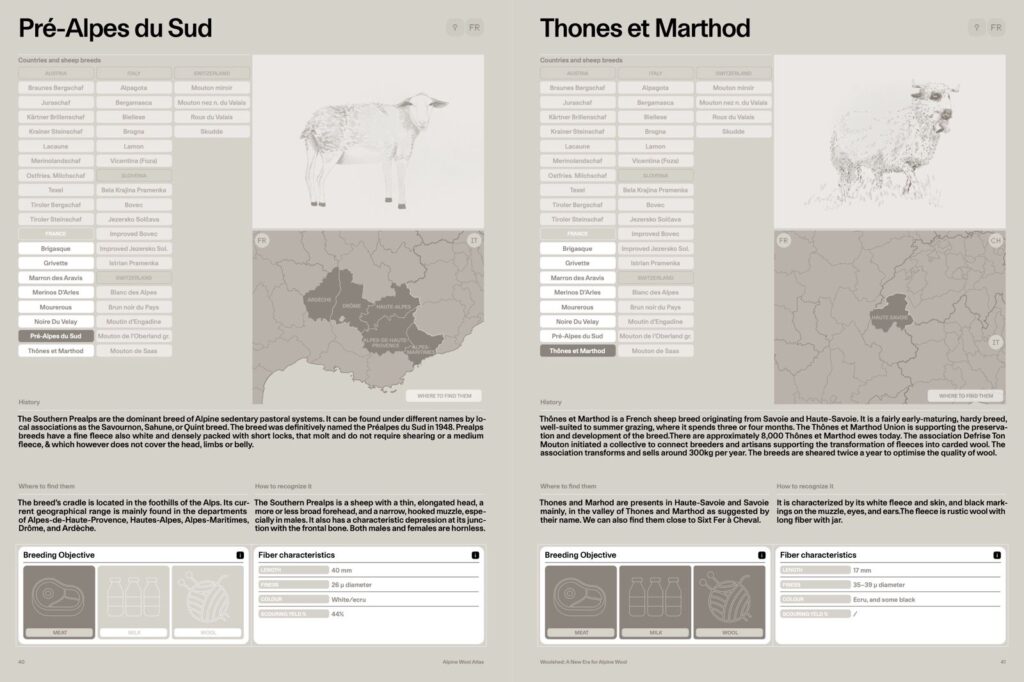
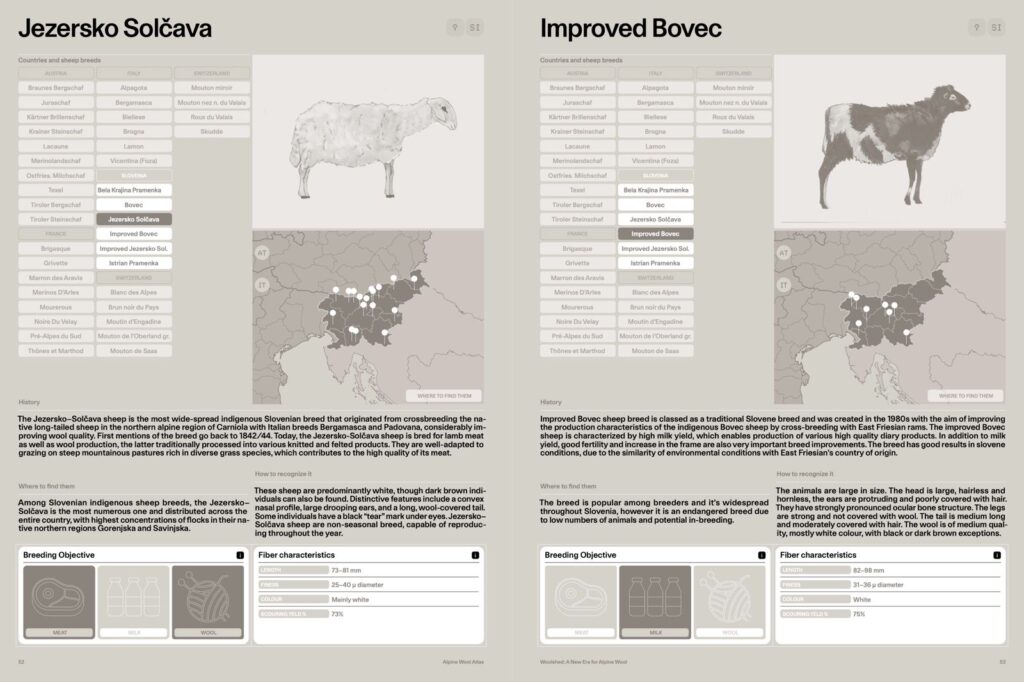
To complement the mapping activity, Iuav University has contributed to the creation of the Digital Alpine Wool Atlas, a tool designed to share knowledge about native wool varieties across the Alpine region. Each entry documents the geographical distribution of a breed, its historical background, and its physical and technical characteristics such as fibre diameter and length. This information guides designers, producers, and manufacturers in choosing the most suitable fibre for specific applications, while also revealing the cultural and historical significance of each wool type.

By promoting awareness of these qualities, the atlas challenges the perception of coarse or rustic wool as a poor or unusable fibre. Instead, it highlights its unique properties and potential applications, from design and fashion to interior and industrial uses, offering new market opportunities and reducing the environmental impact of waste disposal.

Design as a Catalyst for Innovation

To translate research into tangible outcomes, the next phase of Woolshed will focus on the Design Marathons, intensive collaborative events that bring together innovators, designers, artists, and craftspeople to explore creative uses for native wools. These marathons embody the project’s belief in design as a mediator between tradition, sustainability, and technology. They will activate transnational and intergenerational collaboration, inviting local communities to co-create new applications and exchange artisanal knowledge.

By connecting diverse skills mapped throughout the Alpine bioregion, the Design Marathons will foster experimentation and produce innovative materials and products that could not emerge within isolated regional contexts.

Through mapping, open knowledge tools, and design-based collaboration, Woolshed reveals the depth and diversity of the Alpine wool ecosystem. It reactivates local material culture while opening pathways toward circular, sustainable, and digitally connected futures.

The rediscovery of local cultural heritage, environmental and cultural sustainability, and the documentation of material knowledge through design are central to Woolshed’s mission. In doing so, the project aligns closely with the values of the European Fashion Heritage Association, showing how design-led research can bridge past and future, craftsmanship and innovation, local identity and global collaboration.

Edoardo Brunello is a post-doctoral research fellow at Iuav University of Venice, where he earned his PhD in Design Culture of Made in Italy. His research focuses on leather goods as a specific expression of Made in Italy, investigating the design, production, and communication processes that shape the contemporary Italian fashion system. He is a fashion designer and architect. Since 2016, he has been involved in teaching activities within the fashion design courses of the Bachelor’s degree program in Fashion Design and Multimedia Arts at Iuav University of Venice.

Emilia Anna Gordini is a designer currently working as a research fellow at the Iuav University of Venice on the Woolshed Interreg Alpine Space project.
She earned her Bachelor’s degree in Fashion Design in July 2024 with a thesis focused on rustica wool. Her work involved direct and practical experimentation across the entire process — from sheep shearing to the creation of a felted product — while analyzing the current state of European native wool breeds.